CD73-PROTACs for Cancer Therapy
SHORT DESCRIPTION
A novel first-in-class proteolysis targeting chimera (PROTAC) that selectively degrades CD73 to reverse tumor immune evasion and inhibit cancer progression.
INVENTORS
- Bin Zhang*
- Northwestern University Feinberg School of Medicine, Department of Medicine (Hematology & Oncology)
- Gary Schiltz*
- Weinberg College of Arts and Sciences, Department of Chemistry
- Jie Fan
- Jing Cao
- Ping Xie
* Principal Investigator |
NU Tech ID: NU 2025-256
IP STATUS
Provisional patent application filed
DEVELOPMENT STAGE
TRL-6, Prototype Demonstrated in Relevant Environment: Efficacy shown in humanized NSG mouse models of triple-negative breast cancer.
|
BACKGROUND
CD73, an enzyme found in the tumor microenvironment, significantly contributes to cancer progression via its enzymatic activity, which produces immunosuppressive adenosine, and via non-enzymatic mechanisms that support tumor cell adhesion, migration, and metabolic fitness. The presence of elevated CD73 is often linked to poor patient prognosis and resistance to existing immunotherapies. Current therapeutic strategies, such as small-molecule inhibitors and monoclonal antibodies, fail to comprehensively inhibit both the enzymatic and non-enzymatic functions of CD73, are unable to degrade the protein from both cell surface and intracellular compartments, and are susceptible to target rebound, thus compromising their overall clinical efficacy.
ABSTRACT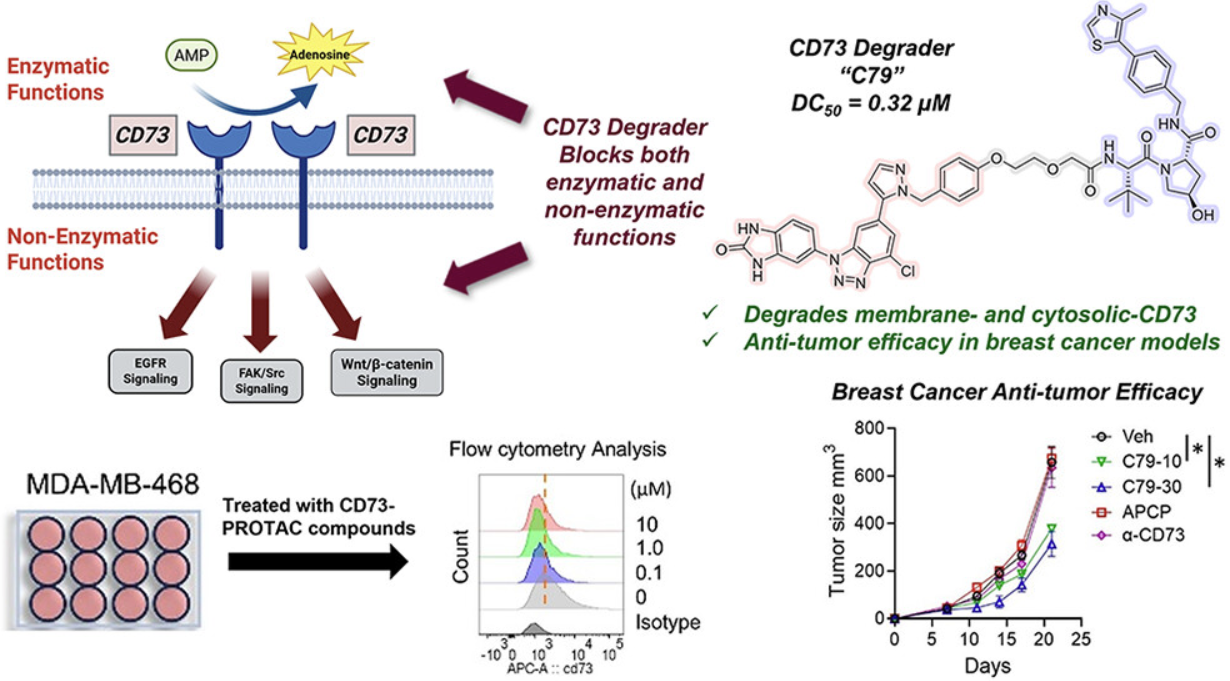
The novel CD73-PROTACs, exemplified by “C79”, are heterobifunctional molecules comprising a CD73-binding ligand linked to E3 ligase recruiters to induce CD73's ubiquitination and subsequent proteasomal degradation. This mechanism effectively depletes CD73 from both cell surface and intracellular compartments. In addition to abolishing its nucleotidase activity and reversing adenosine-mediated immunosuppression, CD79 also inhibits CD73's non-enzymatic functions, including NAD+ biosynthesis, tumor cell proliferation, migration, and adhesion. In pre-clinical models of breast cancer, C79 demonstrated in vivo efficacy, reducing tumor growth without detectable toxicity.
APPLICATIONS
- Cancer immunotherapy: Targets CD73-driven immune evasion in various tumors.
- Targeted cancer therapy: Independent of its immunomodulatory effects, the CD73-PROTAC disrupts tumor cell metabolism, migration, and adhesion.
- Triple-negative breast cancer: Enhances antitumor response in aggressive cancers.
- Therapy for other cancers with elevated CD73 expression.
ADVANTAGES
- Comprehensive inhibition of both enzymatic and non-enzymatic functions of CD73
- Enhanced immune activation: Reverses adenosine-mediated immunosuppression and boosts CD8⁺ T cell function.
- Impairs tumor cell fitness: Reduces intracellular NAD⁺ levels and inhibits tumor cell proliferation, migration, and adhesion
- Reduced potential for target rebound, leading to sustained therapeutic responses
- Targeted approach with potential for lower dosing and reduced toxicity and adverse side effects compared to existing therapies
PUBLICATIONS
Xie et al., Dual Targeting of Nucleotidase-Dependent and -Independent Functions via PROTAC-Mediated CD73 Degradation. J. Med. Chem. (2026).
KEYWORDS
CD73, PROTAC, cancer therapy, immunotherapy, tumor microenvironment, CD8 T cell activation, targeted degradation, proteolysis-targeting chimera, targeted therapy, cancer, oncology
Patent Information:
| Title |
App Type |
Country |
Serial No. |
Patent No. |
File Date |
Issued Date |
Expire Date |
Categories:
Life Sciences > Therapeutics
Keywords:
BIO2026
Breast cancer
Cancer/Oncology
Colon cancer
Lung cancer
Melanoma
PROTAC
Targeted therapy
Therapeutics
TPD - Targeted protein degradation